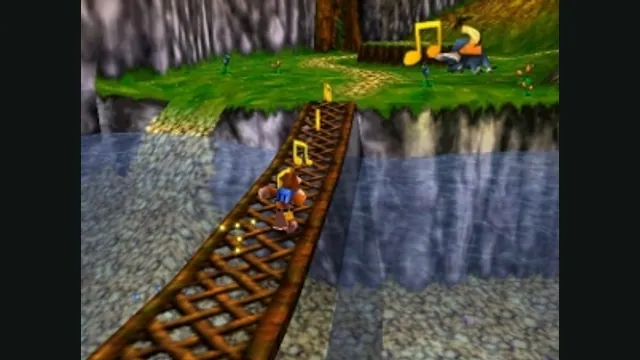
Banjo-Kazooie gameplay reference; not a capture of the linked project.
Image credits ↗The first Donkey Kong Country statically recompiled with native desktop hosts.
 SetupYour game files required
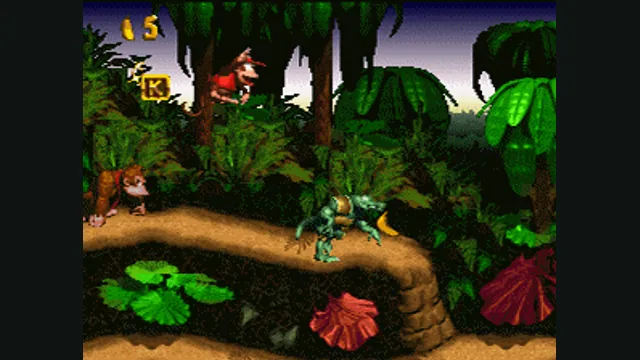
Donkey Kong Country SNES original-game reference; not a DKC1Recomp capture.
Game imagery remains copyright its respective rights holders. Image published at https://en.wikipedia.org/wiki/File:Donkey_Kong_Country_Shot_2.png.
Source & attribution ↗View image ↗The first Donkey Kong Country statically recompiled with native desktop hosts. Playable bring-up, with platform versions and feature sets differing. Experimental widescreen and optional mods are not blanket completeness guarantees.
DKC1Recomp targets the USA 1.0 Super Nintendo version of Donkey Kong Country. It translates the game into a native host while preserving the cartridge’s underlying game logic. The project’s movement and animation work covers familiar actions such as jumping, rolling, carrying and throwing, climbing ropes and swimming.
The developer calls the project a playable bring-up. That is a useful boundary: a generated-code milestone or successful opening level is not a claim that every level, optional mod and host platform has identical completeness.
The port offers the original 256×224 presentation alongside wider views. Its approach preserves the underlying camera, collisions and level boundaries while extending what is shown around them. The Mac host provides several image-sampling choices, from crisp pixels to smoother filtering.
Wider views can expose problems the original screen never showed. The documentation identifies experimental aquatic-level fixes and incomplete coverage of entrances. If a level’s edges look wrong, compare with the original-width mode before concluding that the original game data is damaged.
Windows, macOS and iOS packages have not always advanced together. The README explicitly distinguishes Windows releases with persistent Candy saves from an older accompanying Mac build that lacks the same fix. Read the notes for the file you download, not just the release page’s largest version number.
Desktop controls support keyboard and SDL gamepads. The iPhone and iPad frontend offers landscape touch controls, controller input and ROM import, with sideloaded builds requiring signing for the recipient device. That installation route is separate from opening a desktop app.
The normal input is a headerless USA 1.0 ROM with the exact size and checksum documented by the project. Optional character variants are separate from that baseline. The Baby Kong option, for example, needs a supported Donkey Kong Country 3 donor ROM; it is not evidence that this engine also runs the third game.
Keep ordinary in-game saves distinct from host quick-save features, and preserve the host’s user-data directory when upgrading. Optional music packs and mods also have their own stored selections and resources.
A headerless Donkey Kong Country USA v1.0 ROM, checked against the project’s documented digest. Optional character mods may require a separate supported donor ROM.
Creator-reported · Project guideChoose the release for your platform and import the verified original ROM with the native picker.
Creator-reported · Project guideThe latest checked release has Windows and macOS packages. An iPhone/iPad frontend is documented for an earlier release and requires device-specific signing.
Creator-reported · Project guideKeyboard controls and SDL game controllers are documented, with native remapping options.
Creator-reported · Project guideCandy saves and quick-save/load are documented, with platform- and release-specific persistence notes.
Creator-reported · Project guidePlayable bring-up, with platform versions and feature sets differing. Experimental widescreen and optional mods are not blanket completeness guarantees.
Creator-reported · Project guideBanjo-Kazooie gameplay reference; not a capture of the linked project.
Image credits ↗
Conker’s Bad Fur Day gameplay reference; not a capture of the linked project.
Image credits ↗The N64 game rebuilt around N64ModernRuntime and RT64.
Disney's Hercules gameplay reference; not a capture of the linked project.
Image credits ↗The PlayStation action game recompiled for Windows and Linux.
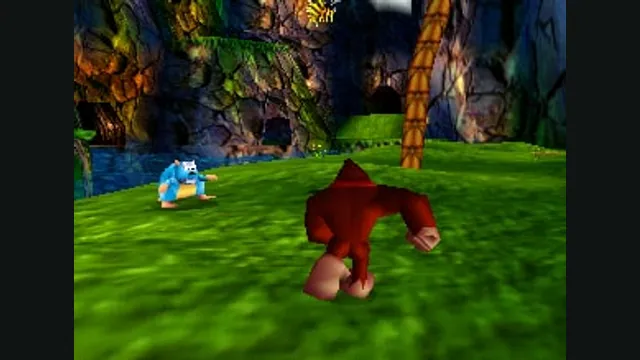
Donkey Kong 64 original-game screenshot reference; not a capture of the linked project.
Image credits ↗